|
|
Introduction |
Flight Instruments |
Engine Instruments |
|
IntroductionSkySports® offers such a large variety of instruments and so many pilots are new to the sport that we felt it was time for a little explanation. While the information is basic, our experience tells us that even seasoned pilots will benefit from some of the information we will present. We hope you won't take offense if we allow some of our opinions to creep into the discussion. Absolute MinimumsFlight safety dictates that every ultralight, air recreational vehicle or experimental aircraft, particularly those powered by two-stroke engines, should have at least two instruments - an airspeed indicator (ASI) and an engine temperature gauge of some type. The airspeed indicator is important to help the pilot maintain airspeed comfortably higher than the machine's stall speed at all times, and, because two-stroke engines are aluminum and prone to overheat if not properly tuned, we think it's necessary to continually take the engine's temperature to avoid sudden silences. After these, the next instrument to consider is a tachometer, then a compass, and finally an altimeter. In addition to these basics, many recreational pilots add vertical speed indicators, slip indicators, air temperature gauges - even clocks - to their panels or instrument pods. All of these instruments offer many choices in terms of size, sensitivity, price, etc. But before we discuss instruments themselves, we want to point out the most fundamental concern anyone should have before buying the first instrument. The topic is vibration. Vibration - the Instrument's Mortal EnemyBy definition, instruments are highly sensitive, complex devices, requiring tender loving care. Yet airframe builders, almost without exception, do not take instruments into consideration when they design their machines. Accordingly, it's up to you to create an environment in which instruments can survive. The biggest problem is high-frequency vibration, generated by the engine and transmitted through the airframe structure. The further away your engine is from the panel, the less vibration. The more turns in the tubing or structure the vibration must negotiate before reaching your panel, the better. Some instruments such as engine instruments, can take quite a bit of vibration. Others, such as the altimeter, can take very little before giving up the ghost. If you have an instrument, of any make or type, whose needle seems to respond but wanders during flight, don't automatically assume you have a bad instrument. It's probably a vibration problem, especially if the wandering seems to come and go as engine speed is adjusted during flight. To be sure, remove the instrument from the mount and fly with it in your lap. The human body is a great vibration isolator. If the unit seems to work fine away from its mount, the problem is obviously vibration. If your airspeed indicator reads what you believe to be excessively high or low (5 mph low to 5 mph high is the factory's standard), it usually is a static pressure problem, not vibration. However, if the needle "wanders" or vibrates, you have a vibration problem. It should go without saying that any tendency of your instruments' needles to wander or vibrate is an indication that you have a vibration problem. Such symptoms are telling you that your instruments are being damaged, and if you don't take corrective measures immediately, you're going to be out a bunch of big bucks. But it is impossible to be specific when it comes to outlining the precautions necessary to keep your instruments happy. Each airframe presents a very different environment in terms of resonance, vibration, shock absorption, etc. The best we can do is give you a few basic "dos" and "don'ts" which should be followed when you are thinking about installing instruments.
Flight InstrumentsAir Speed Indicators (ASI)There are several different types of ASIs. First is the pitot (pronounced pee-toe) or pressure type, the most popular. It compares the pressure generated in a pitot tube aimed into the air stream to the "static" pressure of undisturbed air. Static pressure is obtained through an opening in the instrument case which is shielded form the pressure created by the movement of air past the aircraft by an instrument panel or pod. The venturi-type ASI works on the opposite principal to the pressure ASI. A vacuum is drawn from a venturi mounted in the air stream. The instrument measures the difference in pressure between the vacuum generated by air movement through the venturi and the static pressure. This type was developed in Germany for use in sailplanes, as the pressure (pitot) ASI may not be as accurate at low airspeeds. Its only drawback is that the venturi must be located reasonably close (maximum of 10 feet) to the gauge or the air chamber within the tubing connecting the venturi to the gauge will act as a buffer, reducing the instrument's accuracy. Electrically operated ASIs use propellers mounted into the wind to sense airspeed and communicate the information to the gauge through a wire harness. There are three types:
$ Free Advice $ - Regardless of type of ASI, its pitot, venturi, or propeller must be positioned in clean, undisturbed air. No part of the aircraft, even a wire, should be in front of the sensor, and it should not be within six inches or so of the fuselage, if any. In the case of the venturi, no structural parts of the aircraft can be directly to the rear of the sensor either, as any interruption of the air flowing through the venturi can affect the vacuum and thus the air speed indication. The placement of the ASI sensor is more of an art than a science. It is wise and time saving if the maker of the airframe is consulted for ASI sensor placement before installation. The size of the opening in the end of the pitot tube is not critical, as no air is actually flowing through it. A straight pitot can be substituted, for example, for the "bubble pipe" type pitot supplied with Winter® ASIs if preferred. It can be made from any length, again not critical, of 1/4" diameter aluminum tubing or even automotive brake line. However pitots with larger openings seem to be more accurate at lower speeds and during large changes in the aircraft's angle of attack. AltimetersAll altimeters in general use operate on the same principle: they compare atmospheric pressure at a known point to the pressure of the air around the aircraft in flight (static pressure). Because atmospheric pressure decreases in proportion to height, the altimeter is actually an extremely sensitive barometer, converting the difference in atmospheric pressure into feet above the ground. Most altimeters in general use are mechanical, using an aneroid, or small sealed internal chamber, as the reference point. As you gain altitude, the atmospheric pressure drops, causing the aneroid to expand and, through a gear train, moves the instrument's needle. So-called "non-sensitive" altimeters have one needle which indicates in 100 foot increments. A full 360 degree sweep of the dial usually indicates 10,000 feet, but there are also variations. The decision between a "sensitive" and "non-sensitive" altimeter is not related to quality or accuracy. Both versions are excellent. The choice really depends on which type you feel is easier to read and its price. In general the "non-sensitive" type is less expensive. To complicate things further, "sensitive" altimeters are generally available only in the large, 3 1/8" size, with top readings of 10 or 20,000 feet, while "non-sensitive" altimeters are available in 3 1/8" or 2 1/4" size with top readings of 5,000 or 10,000 feet - your choice. (All altimeters continue to read above their top number without harming the gauge.) But the altimeter decision gets even more complicated. Now you have to decide whether or not you need a "Kollsman" window. The "Kollsman" window (somtimes called a "baro") is a small window in the face of the altimeter on which you set the actual barometric pressure (corrected to sea level) in inches of mercury or millibars. Most ultralight pilots do not require a Kollsman window as they are satisfied to fly from or between uncontrolled airports. However, if you plan to fly in airport traffic areas or near controlled airports, the Kollsman window is a must. It enables you to to set your altimeter to the setting being used at the controlled field by other traffic and thus maintain the proper, legal, altitudes that the heavy iron is flying. And there are more decisions. If you like digital gauges, there are electrically operated altimeters which have no moving parts to wear out and present a high-tech LCD digital display. They translate pressure into altitude with a solid-state piezo-electric device. There are also several styles of watches or "wrist-instruments" which can serve as a back-up or even a primary altimeter when height is not critical. $ Free Advice $ - The most-used altimeter in ultralights is a 10K, one- or two-hand altimeter, without Kollsman window, which reads in 20 foot increments up to 10,000 feet. Available in the 3 1/8" panel mount version and requires no hookups of any kind - just mount and forget. The most popular small (2 1/4") altimeter is the Winter® 5,000 foot panel mount altimeter which has one hand and reads in 100 foot increments. It comes only with a Kollsman window. Because all altimeters are actually reading barometric pressure, the reading changes with the weather. Thus, all altimeters have a set knob which pilots "zero" as part of their preflight. Caution: The altimeter is the most delicate instrument you're likely to install in your machine. While you might get away with just bolting an engine instrument into your panel, an altimeter MUST be protected from vibration or you can count its life in hours. Some pilots simply put their altimeters in their laps or in their pockets. CompassesA compass is a must for anyone considering cross-country flight - and amazingly useful even for flights around the pattern. I know, I was flying from a small farm strip years ago, just two hours after solo and was asked to leave the pattern to give some "graduating" students more room. I did and in two minutes I was lost. Every farmer's field looks like every other field from 2000 feet. Only my knowledge of a freeway location led me back before I ran out of gas. That's when I decided to add instruments to my machine. For most ultralight applications, a well-made, well-dampened automobile or boat-type compass which can be adjusted will serve nicely. For just slightly more money, the recreational pilot can install the Airpath® standard general aviation instrument - the same one used in most light aircraft worldwide. The Airpath is available in a panel or cowl mount version. The problem with either Airpath is its lack of mounting adjustment. If your panel or instrument pod isn't very near vertical, you can't use the Airpath. However, auto or boat compasses can be adjusted to bring them horizontal. Dollar for dollar, the compass is the least expensive and most accurate instrument which can be bought for ultralight or air recreational vehicles applications. Because the compass has an internal magnet which is sensitive to nearby ferrous materials (those containing iron) or electromagnetic devices (coils, meter movements, etc.) place your compass as far away as possible from them - at least four inches. And now you know why some certificated aircraft have the compass mounted on the windscreen above the pilot's head. $ Free Advice $ - Don't leave the patch without one. Vertical Speed Indicators (VSI) and VariosThese instruments tell the pilot how fast, in hundreds of feet per minute, he is climbing or descending - just the thing to check the airframe manufacturer's claims. They are nearly identical to altimeters, with one important
difference. The VSI's aneroid, or pressure sensing device, is
equipped with a "leak" which allows the instrument to slowly
equalize its internal pressure with the atmosphere after the climb
or descent is completed. The VSIs sold for use by the recreational
pilot are identical to those in light aircraft such as the Cessna
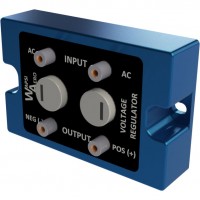
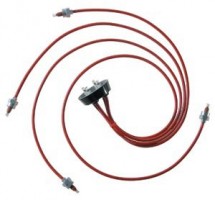
150, 152, etc. The variometer is very similar. It too, indicates the rate of climb or descent in hundreds of feet per minute. However, a vario is much more sensitive than a VSI. Good varios indicate climb or descent rate nearly instantaneously, while VSIs have built in lags of several seconds. And, obviously, the higher the performance, the higher the cost. If your machine's L/D ratio (Lift to Drag) is high enough to enable you to soar with the birds, then you're a candidate for a vario. It can tell you the strength of that thermal and help you locate its heart - essential information for soaring. And, like altimeters, you have choices of size, type, and range. First of all, varios are available in 2 1/4" and 3 1/8" size, panel mount only. You can specify 1000 feet or 1500 feet per minute in either size. But the biggest difference is type. All sizes and ranges of varios are available in mechanical or electrically operated units. The electric types are solid-state and require either a nine-volt battery (mounted in a clamp on the case) or on-board 12 VDC battery power. A 9-volt alkaline battery will last about 15 flying hours, a rechargeable ni-cad, about nine. The mechanical variometer uses pressure in a flask for its reference point. The flask looks like the inside of a thermos bottle and can be placed anywhere convenient. It is attached to the instrument by 3/16" ID plastic tubing. The flask is fragile so should be placed out of harm's way. $ Free Advice $ - If you just want a reference to your climb rate and are not interested in soaring, the VSI is your choice. But if you have a machine with a high L/D (lift to drag) ratio and want to shut off your engine and hunt for thermals, a variometer is a must. It reacts to upward or downward movement almost instantaneously while a VSI takes several seconds. Electrical or mechanical? It's a Ford vs Chevy decision. If you have a panel and changing a battery in the vario is inconvenient, then the mechanical unit is best. If you don't want to have to deal with mounting the mechanical vario's flask and run tubing, then the electrical unit is your choice. Either unit costs about the same. Slip IndicatorsThese are similar to carpenter's levels, but have a black ball instead of a bubble. Their job is to show the pilot whether or not his turns are coordinated - that is, whether the yaw (rudder) and bank (ailerons) are balanced. Slips are useful because it is difficult for even an experienced pilot to determine whether or not his turns are coordinated. These instruments are available in panel-mount versions only, rectangular or 2 1/4" size for surface or behind panel mounting. $ Free Advice $ - While you'll find slip indicators in many ultralight instrument pods, it is usually the last instrument to be installed as its value is a matter of opinion. They are the least expensive instrument you can buy. Static pressure - The Hidden CulpritYou've read reference to static pressure in the discussions of air speed indicators, altimeters, and vertical speed indicators. We tried to make it clear that these devices work by measuring the differences between air pressure in their sensors and the pressure surrounding the instrument, which is presumably "static" which means it is equal to the pressure outside the aircraft. The problem occurs when, unbeknownst to the pilot, the pressure around the instrument is not equal to the pressure outside. If the "static" pressure is not really "static", but higher or lower, the instrument cannot produce an accurate reading. And it's not the fault of the instrument. Such conditions arise when the instrument is exposed - not mounted in an instrument pod or panel in a cabin enclosure. But even an enclosed mounting does not insure that you have truly "static" pressure. Often the air rushing past even a tight cabin or instrument pod will suck air out of tiny openings this creating low pressure inside. And if the pressure is lower at the air speed indicator, the gauge will read faster than actual. Why? Because the instrument is measuring he difference between the air pressure in the pitot tube and that surrounding the instrument. The converse is also true. If the pressure surrounding the instrument is higher than outside, the air pressure difference will be less and the ASI will read slower. Similar effects can be seen at your altimeter. Low "static" pressure makes an altimeter read high, while high "static" pressure creates low readings. If your air speed indicator seems to be working okay, but reads consistently higher or lower than you believe your speed to be, chances are good that you have a "static" pressure problem, not a defective instrument. More than 90 per cent of the air speed indicators returned to SkySports® for replacement under warranty prove to be well within manufacturing tolerance (5 mph) when tested. So what do you do about a static problem? If you have your instruments mounted in an enclosed pod, such as the SkySports® "Ready System", drilling small 1/8" holes in certain areas (see diagram) should handle the problem, though it does little for the pod's esthetics. If, however, you have an enclosed aircraft or a severe static problem with an instrument pod, a very simple but very accurate static system can be installed for just a few dollars that will eliminate the problem. All top quality aircraft speed indicators have two openings in the rear, both of which have "barbed" fittings for attachment to flexible tubing. The center fitting is for the venturi or pitot tubing, the other is your static port. If your ASI does not have a barbed fitting, you'll need a fitting, some 1/4" ID tubing, and, if you're going to hook up more than one instrument, some tees. Next you need a 10" to 20" piece of 1/4" OD aluminum tubing. Plug one end of the tube by epoxying in a wooden dowel. Then simply drill four 1/16" holes around the diameter for the tube, each 90 degrees from the other, 4" from the plugged end. Mount the static tube parallel to the normal air flow - pointing directly into it like the pitot tube. Good spots to mount it are on a wing strut (at least 18" below the wing) or on the cage ahead of all tubes and structure. Hook up the static tube to the air speed indicator's static port with 1/4" ID plastic tubing (and tee to the altimeter, VSI, etc. if necessary). Engine InstrumentsRound or Square?Engine instruments come in two types of housings called "round" and "square". Actually, both have round faces as seen from the front of the panel. The difference is that "round" instruments have a 3/8" deep bezel and mount from the front of the panel and thus hide any hole-cutting sins. "Square" instruments mount from behind the panel in standard 2 1/4" holes and attach with screws in each corner, matching flight instruments mountings such as the airspeed indicator, altimeter, compass, slip, vario, etc. The mechanisms in both types are the same. The "round" instruments cost a little less. HeatYour engine's mortal enemy - Two stroke engines are made from aluminum which has a very high rate of expansion and contraction. As your engine warms up, the piston expands to fill the cylinder properly. If the heat is not controlled, however, the piston will continue to expand until it contacts the cylinder wall and locks - seizing. Or the heat can become so intense that it actually melts a hole in the piston. Engines overheat because they are not getting enough cooling air over their fins, because the fuel mixture they are being fed is too lean (too little fuel to air) or there is too little oil in the fuel. A lean mixture burns hotter, and therefore puts out more power - but there is a fine line between greatest power output and so much heat that the engine seizes or the piston partially melts. While you don't want an extra rich condition (plugs tend to foul) either, it's better and safer to be a little rich than a little lean. You can also create a too-lean condition by not feeding your engine enough volume of fuel, even if the mixture is right. In the parts of the country that experience wide temperature changes, it's necessary to change jets often to compensate. Avoiding overheating is easy. Simply keep your engine tuned to your engine manufacturer's recommendations. And, of course, keep an eye on your heat gauge (CHT or EGT) at all times for any overheating signal. Cylinder Head Temperature Gauge (CHT)The CHT is the choice of the vast majority of ultralight pilots for engine temperature information. The gauge's sensor is a ring which takes the place of the washer under the spark plug. Thus it is sensing the temperature at the most critical spot in the engine. On the most popular CHT, the ring is part of a thermocouple which converts sensor heat into a minute electrical charge and sends it to the gauge which has a range of 0-700 degrees Fahrenheit. Other types of CHTs operate electrically, by sensing the electrical resistance change of the sensor ring as it heats up and sending the information to an analog or digital gauge. Typically, the CHT gauge has a red arc beginning at the temperature which should never be exceeded. The red line on the Westach CHT begins at 450 degrees F., but most feel that 425 degrees F. is the temperature which, if exceeded, indicates trouble. CHTs are inexpensive and are available in 2", 2 1/4", 3 1/8" diameter, and rectangular digital gauges, as well as in combination gauges sharing space with tachometers, exhaust gas temperature gauges, etc. to save panel space. They can also be installed in a special vibration-resistant "can" which, in turn, clamps to a tube if you have no pod or panel. Extensions of ordinary #20 or #22 stranded copper wiring can be added if the standard 4' long thermocouple lead is not long enough to reach from the sensor to the gauge. However, never cut the thermocouple wire itself as it is part of the circuit. No modification needs to be made to the engine to mount a CHT and no outside electrical power is required. $ Free Advice $ - Don't fly without a CHT. Exhaust Gas Temperature Gauge (EGT)This is the other gauge which indicates the temperature of the engine. It takes the temperature of the exhaust gas from a sensor placed in the exhaust manifold or pipe. Most manufacturers specify that the sensor be placed between 4" and 6" from the skirt of the piston. Because it gives you an instantaneous indication of temperature change, the EGT is the gauge to use when tuning your engine as exhaust temperature is the real measure of your engine's internal performance. Again, your engine manufacturer's recommendations as to tuning should be followed. This gauge is available in the same variety as the CHT. $ Free Advice $ - Some pilots swear by an EGT gauge in flight rather than a CHT. However, we believe that the CHT is more important because an EGT cannot tell you when the engine is about to seize, as it is the temperature of the engine metal itself that is critical. Two-stroke engines have a tendency to seize when the power is being reduced after a full power situation when an EGT would be showing a safe engine temperature. Why? Because the engine, at full power, may be able to overcome increasing friction of the expanding piston in the cylinder, but when the power is reduced, and the engine can no longer overcome the increasing friction, the engine seizes. And just when you least expect it. During this same scenario, a CHT would have been showing the increase in cylinder head temperature and alerting the pilot to impending danger. Also, an EGT cannot warn you of a broken cooling fan belt, or for that matter, a lack of oil. Accordingly, we believe in the saying, "Fly with your CHT, tune with your EGT." TachometerThe tach is the basic instrument for engine performance for most ultralights and air recreational vehicles. Though they only tell the pilot how fast his engine is turning, the experienced pilot can tell a lot about his situation from that little tidbit. For example, if the engine will not turn up normal take-off rpm, there is obviously some sort of problem which needs to be solved before take-off is attempted. If the engine is turning more than normal rpms at full throttle, it could mean that the mixture is too lean and that the engine will overheat if full throttle is maintained. Or over revving could mean slipping drive belts, a slipping clutch, loose prop bolts - or even that the wrong prop has been installed. In addition, private pilots are taught to set their cruise speed not by airspeed indication, which is influenced by wind, but by the tachometer. Tachs are made in electrical and mechanical versions, but most recreational tachs use the electric type. Theses instruments count the electrical impulses being generated by the magneto or lighting coils of the engine. Magneto-powered tachometers will not function on capacitive discharge ignition (CDI) systems, so a different tach, called CDI, was designed for engines with CDI systems. It is wired to the lighting coils of the engine. There is a small yellow loop of wire on the back of the tach. This is clipped but not cut off if you have a dual CDI engine. If you hook up a mag tach to a lighting coil you will destroy the tach. But you can hook up CDI tachs to any engine having a lighting coil regardless of the type of ignition it uses. Electrical tachometers are available in a variety of analog (pointer) versions, 2", 2 1/4", and 3 1/8" diameters, and in a variety of dual gauges, sharing space with CHTs, EGTs, etc. None require any additional electrical hookup, and are wired to the kill switch (mag tach) or lighting coils (CDI tach) with #18 stranded, two conductor wire. All are panel mounted gauges, but the "round" gauge can be tube mounted in a special vibration resistant housing. Several digital (LCD) gauges are available as well, usually in conjunction with other gauges. The newest, smallest, and lightest is the SD 101, a self-powered tach/hourmeter combination. It counts the electrical impulses being fed to a spark plug through a pickup wire wrapped around the spark plug wire. Different type engines can be selected with a switch. Either rpms or hours can be selected with the mode switch. Its battery has a five to seven year life. $ Free Advice $ - Install a tach and learn how to use it. We recommend CDI tachs for all engines having lighting coils, as using the lighting coil for the power source takes the tach out of the engine's ignition circuit. This hookup prevents a tach failure from affecting the engine and perhaps ruining your whole day. HourmetersHour meters are available in several versions - the familiar rectangular shaped Hobbs meter which has been the standard gauge used in general aviation for many years - as well as 2" and 2 1/4" diameter panel mount versions and the newer LCD readout digital gauges, usually in combination with other instruments. Many hourmeters require DC power (although SkySports ® does carry AC hourmeters) and are the only instruments discussed which require external power. Because lighting coils are not generators producing AC power, it is necessary to wire a regulator/rectifier into your circuit to power your hourmeter. These are available as low output devices, providing only enough power for your hourmeter, but can be the power source for lights (not strobe lights) and will recharge your battery if you have electric start capability. If you choose the low power device, follow the wiring instructions carefully, as the unit cannot handle the total power being generated by the lighting coils. Hook it up to both the green and the yellow wires - unless you have an ultralight strobe light. Hook up the yellows to the strobe, the greens to the regulator/rectifier. The output of any regulator/rectifier cannot be used for radios as the current is not "clean" enough for solid-state devices. A 12VDC battery is required in the circuit. $ Free Advice $ - Hour meters are a good idea, as there is no other way to determine accurately when it is time for engine or airframe maintenance. Logbooks are fine, but rarely do ultralight pilots maintain them over a long period of time. |
| Home | Get Catalog | Air Stuff | Shop |
|
SkySports has been a "brick-and-mortar" mail-order company for over
25 years. We continue to offer the finest in products and service to our valued customers. We respect your privacy and do not collect information from you (except in our online store) or from your computer. Copyright, 1995-2004. Questions, comments? Email us! |